

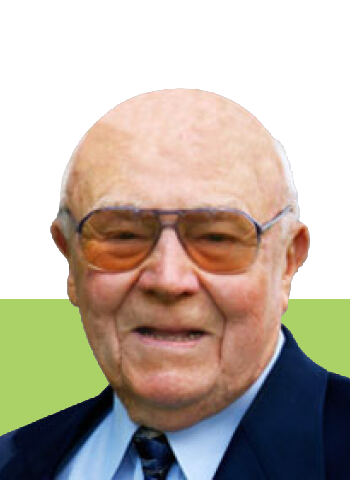

• Howard Brembeck, a successful Midwest entrepreneur, travels to Europe and sees the devastation that was created by WWII. Fearing the potential dangers of nuclear weapons at the height of the cold war, he is compelled to act, and begins exploring how to make a difference.
  • In his company hangar near Goshen, IN, Howard Brembeck held his first meeting with close friends and influential members of the community who share his concerns about weapons of mass destruction. The meetings continue, and over time, he attracts more than two dozen concerned individuals to Goshen to discuss nuclear proliferation and other threats to international security.
  • The Fourth Freedom Forum is established as a nonprofit operating foundation using Brembeck’s own capital, eventually forming an endowment to support its work. The Forum’s offices are initially located in Brembeck’s company hangar and later move to today’s headquarters in Goshen (pictured).
  • The Forum sponsors its first annual roundtable discussion in Florida with retired military officials and foreign policy experts on the subject of nuclear nonproliferation and foreign policy. Over the years, these roundtable meetings grow to include highly influential attendees such as former U.S. Secretaries of Defense, and distinguished military Generals and Admirals.
    Photo: Benjamin B. Ferencz, Former prosecutor, Nuremberg War Crimes Tribunal, and long-time supporter of the Forum; and Robert S. McNamara at one of the Forum’s roundtable discussions (pictured from left to right).
  • David Cortright, a recognized leader in the field of nuclear nonproliferation, joins the Forum as President and establishes a partnership with the Kroc Institute for International Peace Studies at the University of Notre Dame to focus on sanctions and security issues. By this time, the Forum is working regularly with policy experts and thought leaders across the U.S. on issues of global importance.
    Photo: David Cortright, Father Ted Hesburgh, and Howard Brembeck (pictured from left to right).
  • The Forum begins hosting policy meetings in major cities across the U.S. and Europe, and publishing books on United Nations sanctions and incentives. Significant relationships with European policy experts are established and the Forum’s network of global partnerships continues to expand.
  • The Forum establishes a Washington, DC office to access policy makers in the nation’s capital, and hires Alistair Millar, then a senior analyst for the British American Security Information Council and is still today internationally recognized for his work on nuclear nonproliferation and counterterrorism. Millar has appeared on BBC, CNN, Al Jazeera, and Fox News, and has also been published in the Baltimore Sun, the International Herald Tribune, and the Washington Post.
    Photo: Alistair Millar at the Capitol Building in Washington, DC.
  • David Cortright co-authors a book with George A. Lopez from the Kroc Institute titled The Sanctions Decade that is awarded the Publisher’s Choice Outstanding Academic Title Award. The Forum is now partnering with other significant organizations including the Carnegie Endowment for International Peace, U.S. Institute for Peace, Watson Institute, International Peace Academy (now Institute), and the Sanctions Branch at the United Nations.
  • After several years of collaboration with colleagues in India and Pakistan on nuclear nonproliferation publications and programs, the Forum develops significant new partnerships in South Asia. The Forum is now overseeing projects that focus on a dozen countries across the globe including Iraq, Yugoslavia, and Sierra Leone, and is recognized by the United Nations Security Council as one of the leading nonprofit organizations focused on sanctions and security issues.
    Photo: Dr. Samina Ahmed, Research Fellow, Kennedy School of Government.
  • The Forum establishes The Center on Global Counterterrorism Cooperation. Funded by the Forum and with grants from governments and private foundations, the Center collaborates with global organizations, leading experts, and governmental authorities in the U.S., Africa, Asia, and Europe to implement projects providing research, analysis, and recommendations to improve the international community’s response to terrorism.
  • The Forum opens its New York City office to establish closer ties with the UN and its member states on counterterrorism issues.
  • Representing the Forum’s Center on Global Counterterrorism Cooperation, Alistair Millar addresses the UN General Assembly on the occasion of the first review of the UN Global Counterterrorism Strategy, affirming the Center as the leading organization on U.N. counterterrorism issues.
    More 2008
  • The Center serves as secretariat for the International Process on Improving Counterterrorism Cooperation conference sponsored by the UN and five national governments. As a result of this groundbreaking assembly, the Center facilitates workshops in Switzerland, Turkey, Japan, Slovakia and New York focused on assessing the overall contributions of the UN to the fight against terrorism and identifying ways to improve their responses.
    Photo: International representatives at a UN/Center supported “International Process” workshop.
  • Brussels office opens and works with the European Commission to host a groundbreaking meeting for parliamentarians and European Union experts on the importance of promoting and protecting human rights while countering terrorism. And, at the age of 100, Howard Brembeck retires as the Forum Board Chair. David Cortright steps down as Forum President and is appointed the Forum Board Chair. Alistair Millar is promoted to Forum President.
  • The Center conducts trainings on international legal cooperation for judicial officials in four East African locations and brings together police officials from eight South Asian countries for regional workshops on effectively countering terrorism, marking the first time these South Asian groups have ever collaborated in this way.
    More 2010
    Image Source
  • Following the recommendations of the Forum’s Sanctions and Security Research Program at the Kroc Institute at the University of Notre Dame, the UN Security Council appoints an ombudsperson to handle the human rights issues created by blacklisting, and to improve the coordination of human rights protection and counterterrorism efforts.
  • The Center receives support from several governments including Australia and Denmark for multi-year projects focusing on countering terrorist financing in the horn of Africa – Ethiopia, Somalia, Eritrea, and Djibouti; and improving cooperation between counterterrorism and law enforcement officials to help prevent terrorism in East Africa – Ethiopia, Djibouti, Kenya, Somalia, Sudan, and Uganda.
  • Today the Forum is working in many countries around the globe. The Forum and its sponsored programs are internationally recognized as leaders in global counterterrorism issues, “smart” sanctions development and implementation, and promotion of nonproliferation and are highly sought after for advice and recommendations on these critical issues. In partnership with foundations, international organizations, government and intergovernmental officials, and policy experts, we are making the mission of the Forum a reality.
The Forum is a nonpartisan, nonprofit, private operating foundation that is a trusted source for providing realistic solutions to today's most urgent global security threats. Learn More